Why AI Skills for Remote Jobs Matter for Women Restarting Their Careers


Build AI skills to access remote job opportunities and restart your career with confidence.
Returning to work after a career break brings plenty of questions. Are your old skills still relevant? What has changed while you were away? And now another one: do I need AI skills for remote jobs too?
The good news is that learning AI does not mean learning to code. In many work-from-home careers, AI is a tool for research, writing, planning and analysis, much like email or spreadsheets once were.
This article explains why AI skills matter for remote work, how they support a career comeback, which ones are worth learning and how to start without chasing every new tool.
Why Are AI Skills Important for Work-From-Home Jobs?
AI skills are important for work-from-home jobs because remote roles depend heavily on digital communication, research, documentation, analysis and independent task management. Knowing how to use AI well helps you finish some of these tasks faster while still applying your own judgement and experience.
This does not mean every remote worker needs to become an AI specialist.
The workplace itself is changing quickly. LinkedIn's 2025 Work Change Report estimated that 70% of the skills used in most jobs could change by 2030, with AI playing an important role.
The World Economic Forum's Future of Jobs Report 2025 also placed AI and big data among the fastest-growing areas of skill demand, while stressing that human abilities such as analytical thinking, collaboration and resilience will continue to matter.
That combination is important. The future of work is not simply about knowing how to use AI. It is about knowing when to use it and when human judgement matters more.
For someone working remotely, AI might help with:
summarising information
creating a first draft of an email
organising research
generating ideas
analysing basic information
preparing reports
planning content
documenting processes
reducing repetitive administrative work
The professional remains responsible for the final result.
Can AI Skills Support a Career Restart After a Long Break?
Yes. AI skills can help women update their digital capabilities, practise modern workplace tasks and become familiar with how today's teams work.
One common worry after a career gap is: "Everything has changed. Do I have to start from the beginning?"
Usually, the answer is no.
Imagine a woman who worked in administration before taking a six-year career break. She already knows how to organise schedules, communicate with teams, prepare documents, coordinate meetings, maintain records and manage deadlines. Those skills have not become useless.
What may have changed is how those tasks are done. She could now use AI to draft routine emails, summarise meeting notes or create the first version of a process document.
Her previous experience is the foundation. AI is an additional capability. It does not replace what you already know; it updates how you apply it.
How Can AI Improve Your Career Comeback?
Used carefully, AI can support learning, practice and productivity before you return to work. It helps you rebuild familiarity with professional tasks without expecting you to know everything immediately.

A simple way to think about it is in five stages.
1. Relearn. If you come across an unfamiliar term while researching jobs, AI can explain it in simpler language. Someone returning to digital marketing might ask it to explain conversion rate, keyword intent or campaign optimisation before studying them in depth.
2. Practise. AI can be a practice partner. You can simulate interview questions, recruiter conversations, client enquiries, email responses and presentation questions, then compare your answers with suggested improvements.
3. Produce. Once you understand the underlying task, AI can help you create a first version of reports, presentations, content plans, research notes, email drafts, spreadsheet formulas or social media ideas. The important phrase is first version.
4. Review. AI can act as a second pair of eyes. Ask it: "Is this email clear and professional?" "What information is missing from this report?" "Does this presentation answer the client's question?"
5. Improve productivity. For women balancing family or other responsibilities, time matters. AI can reduce the time spent on repetitive first drafts and sorting information, leaving more attention for decisions that need human thinking.
This is where the connection becomes clear:
AI Skills → Productivity → Remote Work → Career Comeback
Which AI Skills Are Most Useful for Remote Careers?
The most useful AI skills are practical rather than technical. For many work-from-home roles, communicating clearly with AI and applying it to a real task matters more than understanding how an AI model is built.
Giving Clear Instructions
Better AI results begin with better instructions. Instead of "Write an email," a stronger instruction explains who the email is for, what happened, what outcome you need, the tone, the key information to include and the length. Providing context, constraints and a clear objective is one of the most transferable AI skills.
AI-Assisted Research
AI can help you explore a topic, identify questions and organise information. It should not be treated as an authoritative source, especially for statistics, policies, medical or legal information and business decisions. Verify those with trustworthy sources.
AI-Assisted Writing and Communication
Many remote jobs involve written communication. AI can draft emails, reports, presentations, social media content, meeting summaries and documentation. You then bring the accuracy, tone and context.
AI-Assisted Data Organisation
AI can help categorise information, suggest spreadsheet formulas, spot patterns, summarise tables and explain basic reports.
AI Workflow Thinking
Learn to recognise repetitive tasks. Ask yourself: "Which part of this task needs my judgement, and which part could be simplified or automated?" That mindset improves productivity even before you use sophisticated automation tools.
Evaluating AI Output
Perhaps the most important AI skill is knowing when the answer is wrong. Before using anything AI produces, ask:
Is it accurate?
Does it answer the actual question?
Is anything missing?
Does it sound like me or the organisation I represent?
Does it need professional or human judgement?
Knowing how to check AI is just as important as knowing how to use it.
Which Work-From-Home Careers Can Benefit From AI Skills?
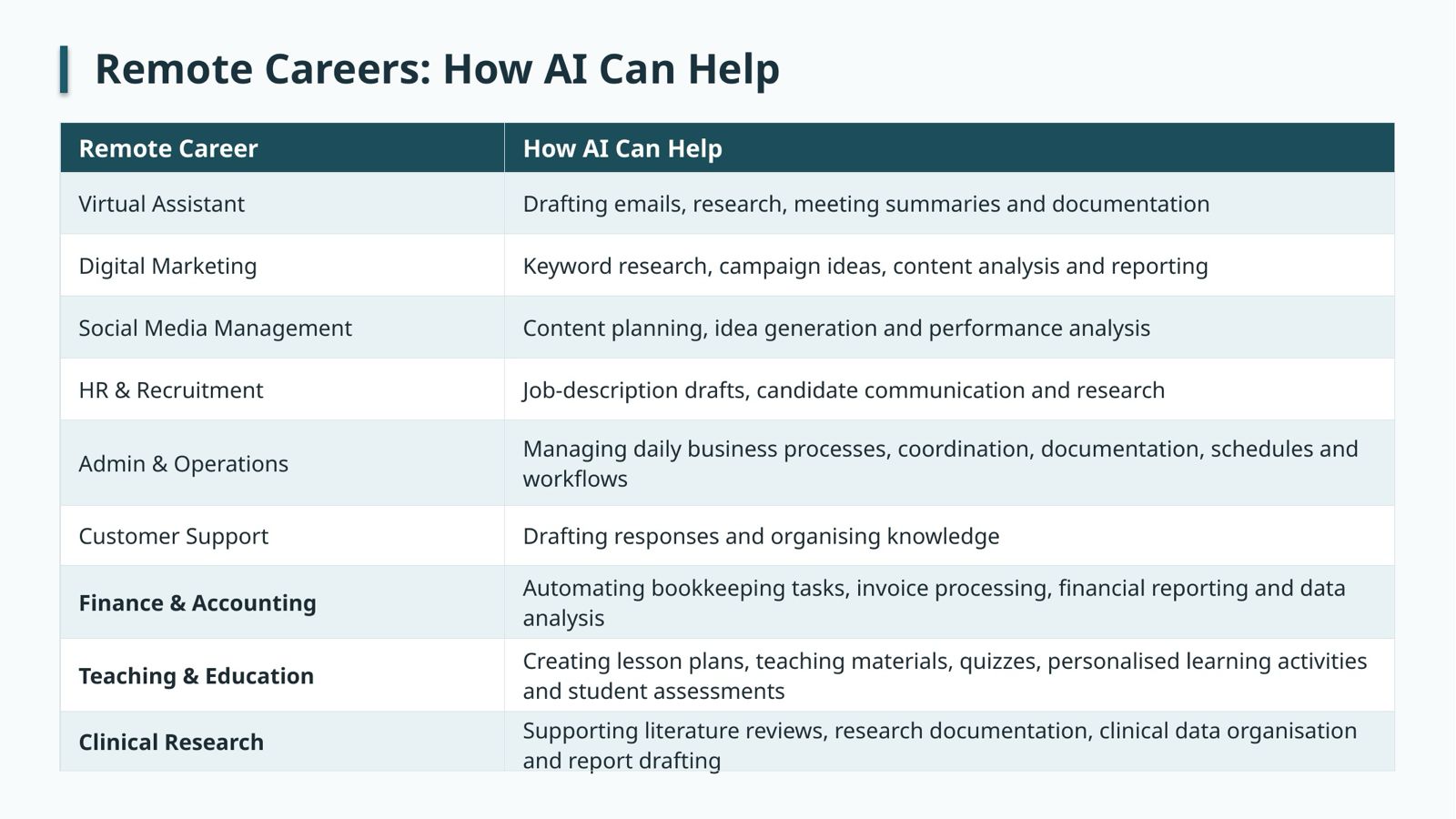
AI is increasingly part of everyday digital work in many fields, not only technology jobs. She Starts currently highlights AI-integrated remote career pathways in Virtual Assistance, Digital Marketing, Social Media, HR, Data Analytics and Operations.
That is useful for career returners because you do not have to change your entire professional identity. You can add AI capability to a direction that already suits your strengths.
Do You Need Coding Skills to Use AI for Remote Work?
No. Many everyday AI skills for work-from-home jobs do not require coding.
A digital marketer may use AI to explore keywords. A recruiter may use it to draft a job description. A virtual assistant may use it to summarise information. A social media manager may use it to organise a monthly content plan. An operations professional may use it to create the first version of a process document.
These are examples of using AI, which is very different from building AI systems. Programming is valuable for technical AI careers, but it is not a requirement for every professional who wants to be AI-literate.
For most women making a comeback, the question is not "How do I learn AI engineering?" It is "How can I use AI effectively in the career I want?"
Which AI Programmes Are Useful for a Career Restart?
A useful programme teaches more than the buttons inside one AI tool. It helps you understand how AI fits into real workplace responsibilities.
Before joining one, ask whether it includes:
practical AI exercises
role-specific learning
real or simulated workplace tasks
projects that demonstrate capability
responsible AI practices
career guidance and interview preparation
This matters because tools change rapidly. Learning only one platform leaves you dependent on it, while learning to solve work problems with AI gives you a transferable skill.
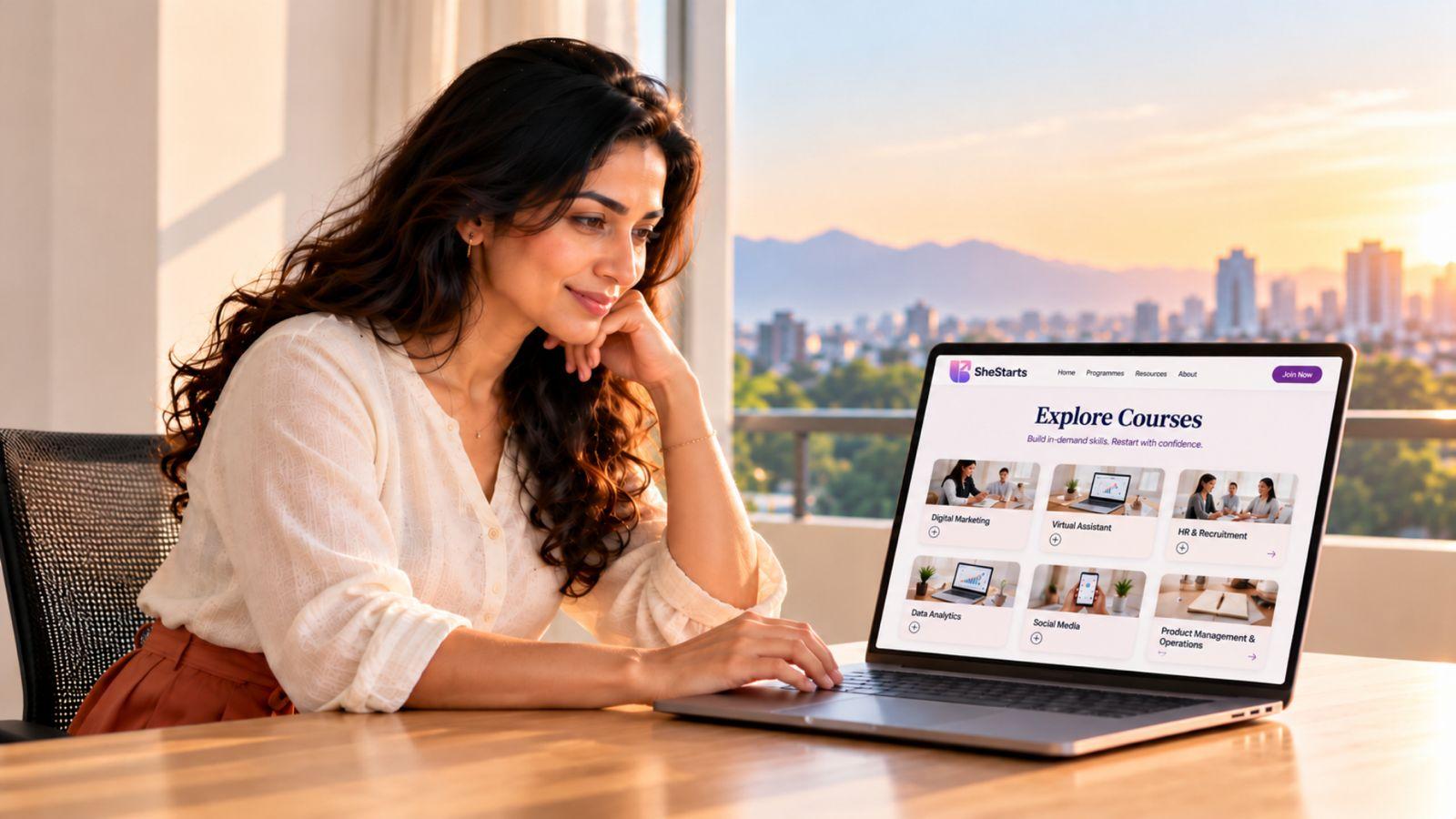
She Starts provides AI-integrated career restart programmes and helps women build a work-from-home career. She Starts follows a career-restart model that combines role selection, AI-integrated skills, work simulations, profile preparation and career support. Whichever programme you choose, look for practical application rather than certificates alone.
How Should You Start Learning AI Skills After a Career Break?
Start with your target career, not with AI. Trying to learn ChatGPT, Gemini, automation, image generation and every new platform at once is overwhelming. Choose a small number of tools that help you do the tasks of your target profession.
Step 1: Choose one target career. Instead of "I want a work-from-home job," try "I want to restart in digital marketing" or "I want to explore virtual assistance."
Step 2: List the common tasks. Look at job descriptions and note the tasks that appear repeatedly. For a social media role: researching topics, planning content, writing captions, creating visuals, scheduling posts and analysing performance.
Step 3: Identify where AI can help. Ask which parts of those tasks AI could support. You now have a relevant AI learning plan.
Step 4: Practise through small projects. Instead of watching tutorial after tutorial, complete a task: a one-week social media plan, a competitor research document, a customer email sequence or an analysis of a simple spreadsheet.
Step 5: Save your best work. Your learning should gradually become evidence of capability:
Learn → Practise → Create → Review → Show Evidence → Apply
That is much stronger than collecting AI certificates. Certificates show you completed training; projects show what you can actually do.
What Mistakes Should Career Returners Avoid When Learning AI?
The biggest mistake is believing that knowing one AI chatbot makes you "AI skilled." Employers are more likely to value people who use AI appropriately while still demonstrating real professional knowledge. Two more are worth avoiding.
Depending on AI instead of learning the skill. If you are learning digital marketing, you still need to understand marketing. If you are learning HR, you still need to understand recruitment and employee processes. AI supports professional capability; it does not replace the need to build it.
Sharing confidential information. Do not enter private client information, passwords, sensitive company data or personal records into AI tools unless the organisation has specifically approved the system and its use.
Will AI Replace Remote Workers or Change How Remote Jobs Are Done?
AI is likely to change many work tasks, but that is different from every remote profession disappearing. The World Economic Forum projects significant job creation and displacement through 2030, with technology contributing to both, and continues to emphasise human skills alongside technological ones.
The safer long-term strategy is neither ignoring AI nor assuming it can do everything. Combine AI capability with what remains distinctly human: judgement, empathy, communication, creativity, accountability, relationship-building and contextual understanding.
For a career returner, the goal is not to compete with AI. It is to work effectively with it.
What Should Your First AI Skill Be for a Career Comeback?
Your first AI skill should be the one most closely connected to the job you want. For many non-technical remote careers, a good start is giving AI clear instructions and applying its output to a genuine workplace task.
Try this one-week challenge:
Choose one remote career you want to explore.
Write down five common tasks in that role.
Choose one AI tool.
Practise three work-related tasks with it.
Improve every output yourself.
Save one finished example as evidence of your work.
That is already more meaningful than trying to memorise dozens of AI tools.
Frequently Asked Questions
Why are AI skills important for work-from-home jobs?
Many remote careers involve digital communication, research, documentation, analysis and independent task management. AI can support these activities and help professionals work more efficiently when combined with human review.
Can AI skills support a career restart?
Yes. They help women update their digital capabilities, practise modern workplace tasks and become familiar with current ways of working, complementing previous experience rather than replacing it.
How can AI improve my career comeback?
AI can support learning, interview preparation, research, communication, project creation and everyday productivity. Its greatest value comes when combined with professional knowledge and human judgement.
Which AI programmes are useful for remote careers?
Look for programmes that connect technology with practical workplace tasks, role-specific learning, projects, simulations and career preparation. Programmes focused on one tool may become outdated quickly.
Do I need coding skills for AI-based remote jobs?
Not necessarily. Many remote jobs in marketing, HR, administration, virtual assistance, social media and operations require practical AI literacy rather than programming.
Which remote careers can use AI skills?
Virtual assistance, digital marketing, social media management, HR, operations, customer support and data-related roles. The most useful skills depend on the actual responsibilities of the job.
AI Skills Can Become Part of Your Career Comeback
A career break does not mean everything you learned before it has lost its value. What may need updating is how you apply those skills in today's workplace.
Learning practical AI skills can help you feel comfortable with modern workflows, work more productively and build evidence that you are ready to work again. You do not have to learn every new AI platform, become a programmer or reinvent your career.
Start with one career direction. Understand the work. Learn how AI supports that work. Practise it. Build something you can show.
If you are unsure which remote career fits your experience, strengths and current responsibilities, She Starts offers career-restart pathways that combine role clarity, AI-integrated skills, practical work simulations and career preparation to help women move towards a structured career comeback.
Your next career does not have to begin with knowing everything about AI. It can begin by learning how to use AI well for the work you want to do.